March 14, 2026
Open Source Is the Backbone of Every Community
Open source isn't just about software. It’s a philosophy of shared knowledge that has powered communities, science, and innovation for centuries.
Most people think open source is about code on GitHub. It’s not.
Open source is about shared knowledge. It’s the idea that when humans openly share what they know, everyone moves forward faster. Communities grow, tools improve, and innovation becomes accessible to anyone willing to learn.
Long before software existed, open source thinking already shaped human progress.
Open source existed before software
The concept is older than the internet.
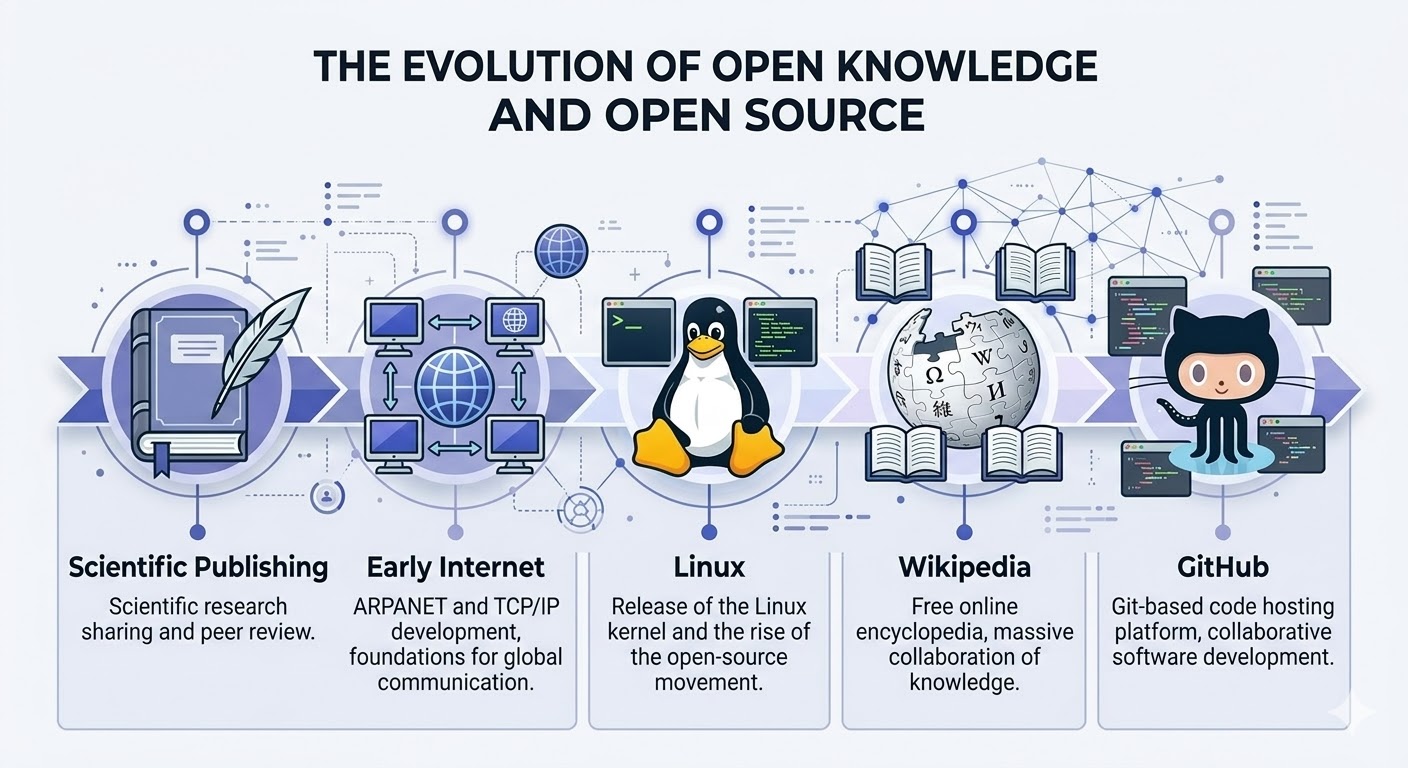
Scientific research has always depended on openness. When Isaac Newton wrote about gravity, he didn’t keep the idea private. When scientists publish research papers today, they share their findings so others can build on them.
The same principle exists in:
- Academic research
- Medicine
- Education
- Public libraries
- Wikipedia
- Open datasets
- Open standards
Every time knowledge is shared freely, the next person can start from a higher point.
That is open source thinking.
The modern open source movement
Software simply gave this philosophy a new medium.
In the 1990s, developers began sharing source code publicly so others could study it, modify it, and improve it. Instead of one company building something alone, thousands of people could collaborate.
Projects like these changed the internet:
- Linux — the operating system that runs most of the internet
- Apache — powered a large portion of early websites
- MySQL / PostgreSQL — open databases used globally
- Python — one of the most widely used programming languages
- WordPress — powers a huge portion of websites
Many of the tools we use daily exist because people shared their work.
You might not realize it, but open source runs most of the digital world.
Real-life example: the internet itself
The internet is built on open standards.
Protocols like:
- HTTP
- TCP/IP
- HTML
were openly documented so anyone could build technology that connects to the web.
Imagine if the internet had been proprietary.
Every website would require permission. Innovation would slow dramatically.
Instead, open standards allowed millions of developers and companies to build on the same foundation.
Open source is not just for developers
One of the biggest misconceptions is that open source is only about programming.
Open collaboration exists everywhere.
Wikipedia
Wikipedia is one of the largest open knowledge projects in history.
Millions of volunteers collectively maintain a free encyclopedia used by billions of people.
Open science
During the COVID-19 pandemic, scientists shared genomic data and research openly. This accelerated vaccine development dramatically.
Open collaboration saved time when the world needed it most.
Open educational resources
Universities and educators now publish open textbooks and learning material.
Examples:
-
MIT OpenCourseWare
https://ocw.mit.edu/ -
Khan Academy
https://www.khanacademy.org/
Anyone with internet access can learn from some of the best institutions in the world.
Communities built around open source
Open source is really about communities.
A good open source project is not just code. It includes:
- contributors
- maintainers
- documentation writers
- educators
- users giving feedback
These communities teach each other.
People often learn their first programming skills by reading open source code written by others.
Many careers have started this way.
Businesses built on open source
Open source does not mean no money.
Many successful companies build businesses around open projects.
Examples include:
- Red Hat — enterprise Linux services
- GitHub — hosting and collaboration platform for open code
- Elastic — search and analytics tools
- Docker — container technology used worldwide
The idea is simple.
The core technology is open, but companies provide services, infrastructure, or enterprise tools around it.
This creates a balance between sustainability and openness.
Why open source is sustainable
Open systems survive longer than closed ones.
When knowledge is shared:
- innovation compounds
- communities maintain the work
- knowledge survives beyond individuals
- anyone can build improvements
Closed systems depend on a single company or owner.
Open systems depend on people.
History shows that communities are far more resilient.
The quiet infrastructure of the modern world
The internet runs on open source.
Phones use open source libraries.
Cloud infrastructure runs Linux.
AI tools depend on open frameworks.
Even companies that build proprietary products rely heavily on open foundations.
It’s invisible, but it’s everywhere.
How you can participate
You don’t need to be a programmer.
You can contribute to open ecosystems by:
- writing documentation
- fixing typos
- translating content
- sharing educational resources
- publishing research openly
- supporting open communities
Open source is participation.
It’s how humans collectively build knowledge.
Some great reads on open source
- The Cathedral and the Bazaar — Eric S. Raymond
- The History of Open Source
- How Linux Took Over the World
- Why Open Source Matters
Final thought
Open source is not a technology movement.
It’s a human one.
Whenever knowledge is shared openly, communities grow stronger. Innovation spreads faster. And the next generation starts from a better place than the last.
That’s why open source will always outlive any single company, platform, or trend.